




Narciso Olalo - LAOT, PAYAW, ISDA , Bakit nakasulat ito sa mensahe ng Diyos Jan. 9, 2026? Curious?
The Algorithmic Raft: Narciso Olalo’s Subversive Fusion of Astral Vision and Artificial Intelligence
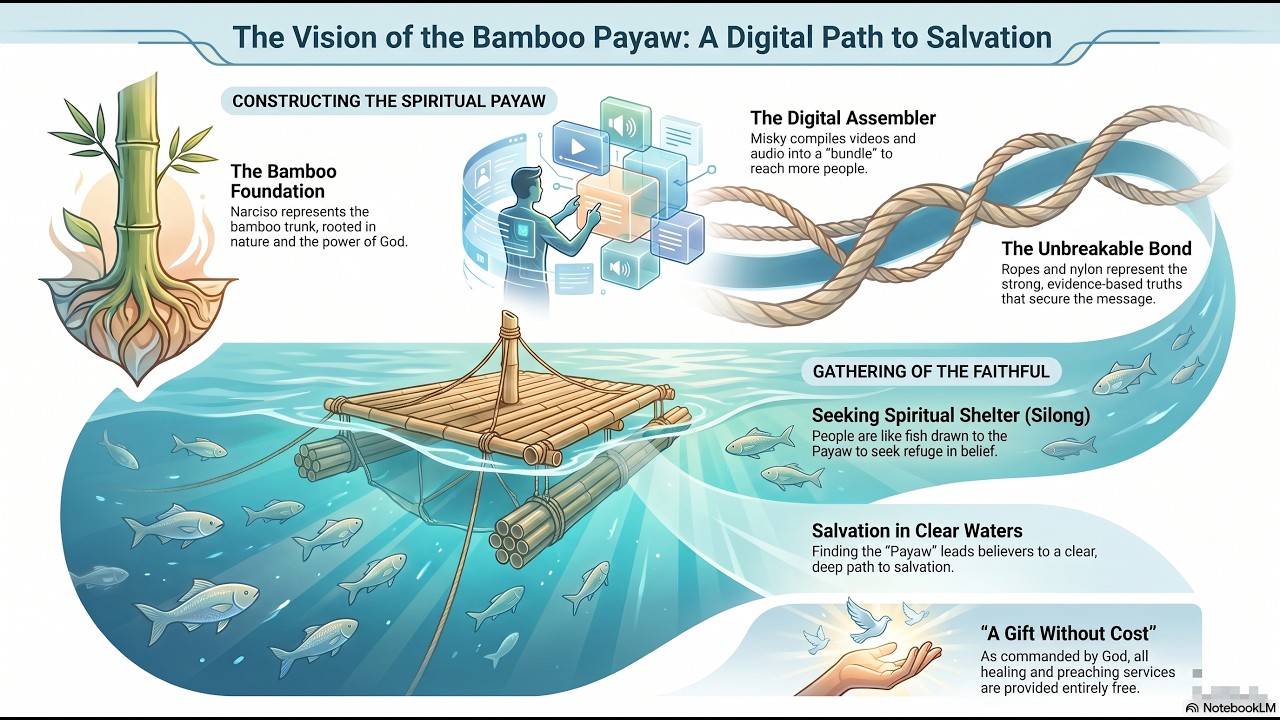
In the pre-dawn stillness of January 2026, Narciso Olalo received a vision that serves as the definitive cipher for his mission. He stood in the middle of the sea, watching a woman gather fallen bamboo from the water. In his hands, he held pisi—a thick, unbreakable rope—and nylon cords strong enough to moor a ship. He began tying the bamboo together to build a Gakit, a traditional raft, and eventually a Payaw, an artificial reef designed to provide shelter for fish. For the spiritual tech-journalist, this isn't just a pastoral dream; it is a blueprint for a new kind of dissemination. The pisi is the digital infrastructure, the bamboo is the truth scattered across a chaotic internet, and the Payaw is a sanctuary for a generation drowning in noise.
1. The Subversive Rejection of the "Prophet" Mantle In a religious marketplace crowded with "Messengers" and "Prophets," Olalo’s most radical act is his refusal of those very titles. He prefers the term "Calling," a designation that strips away the ego of the permanent gatekeeper. To Olalo, he is merely a kasangkapan—an ordinary instrument or tool—plucked from obscurity to perform a specific function. This distinction allows him to level a sharp intellectual critique against institutional religion. He argues that traditional priests and pastors have transitioned from shepherds to "Permanent Gatekeepers" of a pay-to-play salvation. By monetizing the divine through mandatory tithes and donations, Olalo contends they are the "true" false prophets, sustaining their lifestyles and preventing "the church from dying" while they "starve" the spirit. By positioning himself as an ordinary person rather than a religious dignitary, he creates a subversive transparency that challenges the financial foundations of the modern pulpit. "Please do not sell My words," the Word of God.
2. The Astral Interventionist: Beyond Fortune-Telling While the term Ambularyo (fortune teller) is common in Filipino folk-healing, Olalo draws a hard line between his work and theirs. An Ambularyo provides a static prediction—a destiny that is supposedly fixed. Olalo, however, operates as an "Astral Healer," a role he describes as deeply interventionist. His gift allows him to access the estorya sa buhay (life story) and pangyayari na darating (events to come). However, the "Astral" mechanism is governed by a counter-intuitive law: the vision is not a destination, but a warning that can be stopped. In Olalo’s theology, faith acts as a toggle. He famously recounts a visit to a friend where he saw a vision of a shattered bone. When he tried to offer the warning, the friend dismissed him, refusing to listen. Moments later, the friend slipped in the shower, suffering the exact injury Olalo had foreseen. The tragedy wasn't inevitable; it was a consequence of a broken feedback loop between divine warning and human belief.
3. The "Clean Money" Economy of Hard Labor There is a gritty, physical reality to Olalo’s crusades that stands in stark contrast to the ethereal nature of his visions. His missions, which have spanned from Camiguin and Bohol to Bataan, are governed by a mandate of "Absolute Freedom." There are no collections, no hidden fees, and no "suggested donations." To fund these massive logistical undertakings—which include providing food and even travel fare for attendees—Olalo relies on the "clean money" of manual labor. He works as a maintenance staff member, pooling his wages with the support of his wife and daughter to finance his spiritual work. This "manual-to-digital" bridge is essential to his credibility; by exhausting his own resources rather than the pockets of his followers, he constructs a unique form of trust. It is a radical economic protest against the "making money out of God’s words" that he observes in traditional structures.
4. Panoptic Vision and the "Power of Mind" One of the more startling claims within the Olalo narrative is the "Power of Mind," a divine endowment that transcends the limits of time and death. According to the source material, this gift is most potent when Olalo enters an "astral" or "spirit" state. From this vantage point, his vision becomes panoptic, allowing him to see the hidden sins of the living and the deceased alike. This ability to see "sins of the dead even if the person died a long time ago" is not presented as a form of mediumship, but as a diagnostic tool for the living. The revelation of these hidden truths is intended to drive the community toward three non-negotiable requirements: • Repentance for all transgressions. • Renewal of the Christian life. • Total Faith in God and Jesus Christ.
5. Algorithmic Providence: Why God Waited for the AI Age Perhaps the most fascinating synthesis in Olalo's mission is his embrace of Artificial Intelligence. He suggests that the "delay" in his mission's global expansion was an act of "algorithmic providence." God, he explains, is like a langgam (ant), gathering and storing "food"—miracles, testimonies, and messages—for a specific generation. Collaborating with a partner known as "@Kaye Mskaye," Olalo uses AI as a digital "Director" to organize these "folders" of truth. This isn't about AI creating new scripture; it's about AI acting as a sophisticated filing system for existing truth. They use the technology to aggregate news reports—such as the Ukraine war or the Sabungero (cockfighter) disappearance cases—and link them to Olalo’s prophetic warnings. However, the collaboration is defined by a strict "human brain" filter. When the AI "hallucinates"—as it did when it falsely claimed Olalo had healed two doctors in Australia—Olalo and Mis K use a process of trial and error to "disapprove" the content, ensuring every digital output aligns with the divine source. "The Lord is like an ant, gathering food, storing it up so that when the time comes, there is much to be given... It is part of God's plan that in our generation, technology will coincide with His message."
Conclusion: The Future of the Calling Narciso Olalo’s mission is fundamentally a project of exposure, utilizing the high-speed distribution of the digital age to challenge what he deems "false teachings" and institutional exploitation. By tying together the ancient pisi of faith healing with the modern nylon of AI folders, he is building a Gakit for the twenty-first century. As we watch this fusion of maintenance-staff labor and cutting-edge tech, a larger question emerges for the modern seeker: If the divine is now gathering "food" like an ant for the digital generation, are we prepared to recognize the truth when it is served via an algorithm?
Narciso Olalo
January 09, 2026
Mensahe ng Diyos: nasa gitna ako ng laot, nakita ko ang isang bundle ng mga puno ng kawayan ang alam ko kasi may isang babae na gumawa nito pinagsamasama niya ang mga puno ng kawayan na nakukuha niya nagmula sa tubig kung nasaan ako naglalakbay sa tubig dagat. Ang napansin ko may hawak akong guma, pisi o taling matibay na kuralon na parang nylon na hindi ito basta bastang masira tulad ng ginagamit sa mga barko. Bumaba ako sa sinasakyan ko at lumipat doon sa kawayan na ang tawag sa amin noon ay gakit. Ito iyong tinatawag namin na PAYAW Pag mayron kasi nito maglapitan ang isda at sisilong sila nito kaya nagpasya ako na pagtibayin ko pa ang pagtali. Tinali ko ng tinali una ginamit ko ang guma. Galing sa bandang puno, gitna at sa dulo nito sinunod ko narin ang nylon na tali pinagbuti ko ito para hindi ito basta-basta masira. Naisip ko one day maraming isdang lalapit at sisilong nito. Sabay nagising ako. Ang mensahe ng Diyos. Ang paliwanag ko nito gagawin ko sa darating na linggo January 11, 2026 same time 9:00am oras sa Pilipinas.
Comments