




Narciso Olalo s Surreal Facebook Doomsday Prophecies
The Prophet in the Feed: 5 Impactful Insights from the Visions of Narciso Olalo
In an era of relentless algorithmic noise, a primal human curiosity persists: the desire for a sentinel, a voice that can discern the tectonic shifts of fate before the ground actually gives way. We are a species obsessed with the "warning," yet we are often paralyzed by the medium through which it arrives. Enter Narciso Olalo, a self-described "divine instrument" who has spent the last 16 years—leading up to this pivotal June of 2026—meticulously documenting visions that blur the line between spiritual alarmism and digital activism. To some, he is a fringe figure; to others, he is a modern-day watchman deconstructing the commercial machinery of salvation from his social media feed.
1. The "Cow" of the Earth: The Sensory Anatomy of a Quake Olalo’s vision from June 10, 2026, offers a surrealist yet profoundly sensory interpretation of seismic disaster. He describes a cow drinking from a crack in the earth—a scene that serves not as a literal pastoral warning, but as a metaphor for the earthquake’s physical presence. While seismologists track magnitudes and epicenters, Olalo tracks the dagongdong—the thundering metabolic roar of the earth. Unique to his prophecy is the onomatopoeia "NGA... NGA...", the Bisaya/Tagalog vocalization of a cow’s lowing. In Olalo’s framework, this isn't just animal noise; it is the auditory signature of the landslide itself. It is a hauntingly relatable way to describe the groan of shifting plates and the subsequent "balding" of mountains as greenery is stripped away by the force of nature. "In a moment I heard the sound of the cow saying NGA..... NGA..... from what I heard followed the thundering sound (dagongdong) that seemed to come from the mountain... the mountain had a landslide that was so wide as far as my sight could reach. The green of the trees and grass disappeared as if the mountains were bald."
2. The "Sand vs. Gravel" Paradox: Deconstructing Mainstream Salvation Olalo’s most biting critique is directed at institutional religion. He utilizes a "sand and gravel" metaphor to illustrate a harsh spiritual reality: the "many" who follow the crowd are the sand that will wash away, while the "few" who truly repent are the gravel that remains. He explicitly challenges the modern comfort that "God is love" implies universal, effortless forgiveness. Furthering his role as a spiritual analyst, Olalo claims a "Power of Mind"—a divine gift that allows him to see the life stories and sins of both the living and the long-dead. This is not just about morality; it is a rejection of what he views as the hollow rituals of the Church. Mainstream Institutionalism: Relying on "pista" (feasts), masses, and the intercession of priests/pastors for salvation. The Olalo Directive: A total rejection of these "false teachings" in favor of individual repentance and renewal. The Result: The "Sand" (the religious majority) will perish in the coming disasters, while the "Gravel" (the small, repentant remnant) will be saved.
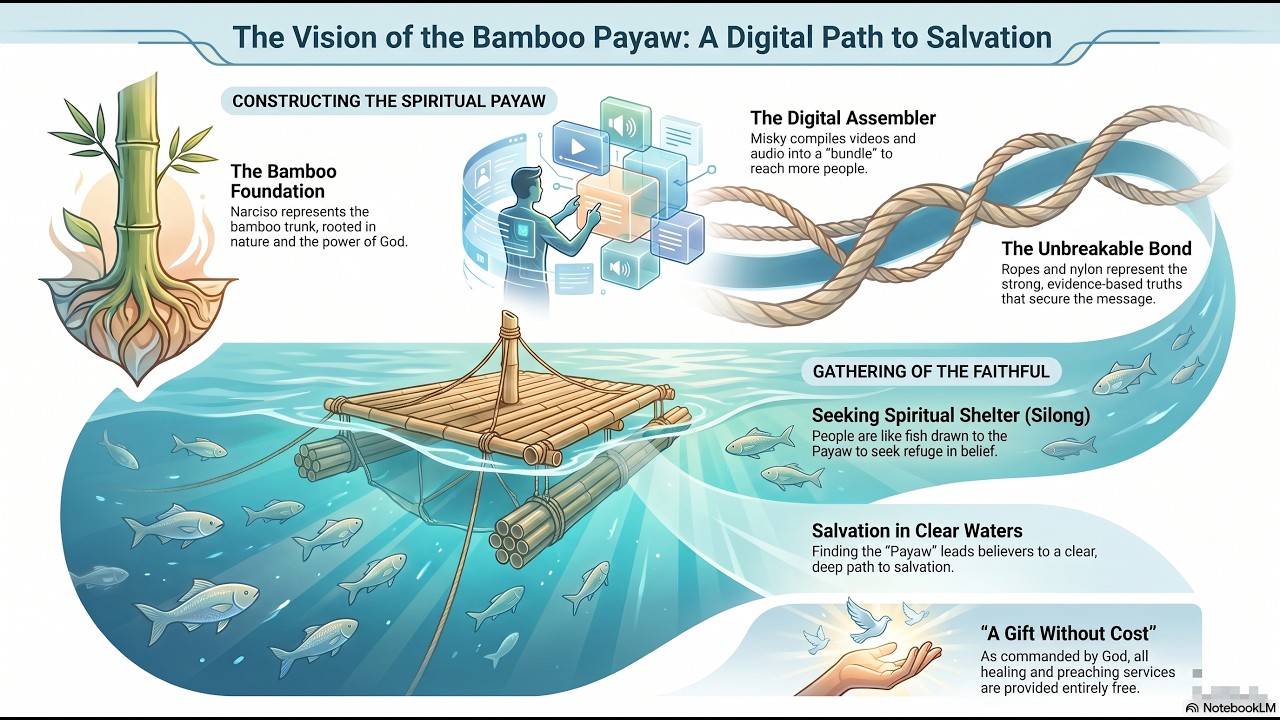
3. The Ethic of the "Free" Miracle: A Critique of Commercial Faith In a landscape dominated by the prosperity gospel, Olalo’s stance on spiritual labor is a radical outlier. He operates under an absolute mandate: he must not collect a single cent for healing or preaching. This directive creates a stark contrast with the socio-economic pillars of religion in the Philippines, where tithing and financial offerings are often the gatekeepers of divine favor. By insisting his work be "absolutely free," Olalo positions himself as a direct threat to the commercialization of faith. He views the act of charging for a miracle as a corruption that invalidates the gift itself, an "investigative" stance that demands we look at why we have come to expect a price tag on the holy. "YOU CAN HEAL AND PREACH TO THE PEOPLE BUT NO MONEY SHOULD BE COLLECTED, WITHOUT CHARGE EVEN A SINGLE CENT. IT SHOULD BE ABSOLUTELY FREE... I HAVE THE HEALING POWER TO CURE PEOPLE ACCORDING TO THEIR FAITH IN YOU THAT I AM USING YOU AS MY INSTRUMENT."
4. The Vision of the "Red Paper": The Collapse of the Infrastructure Olalo’s prophecies frequently utilize domestic symbols to represent systemic failures. In one particular vision, he describes a square paper with reddish coloring ("may pagkapulang ka tinakpag ng plastic"), covered in plastic. He identifies the figure "Susan" as being central to this preparation. Olalo interprets the square paper as nurse and patient records, and the red as the blood of the injured. This is a specific, localized warning for the "Big One" hitting Manila. His analysis is chilling: he predicts that when the disaster strikes, the hospital system will not just be overwhelmed—it will be physically "closed" and unable to function, leaving the injured with nowhere to turn. The plastic covering on the records suggests a preservation of the dead’s history in a world where the living can no longer help them.
5. The "Woman at the Window": The Psychology of the Silent Lurker Perhaps the most culturally poignant of Olalo’s reflections is his frustration with his lack of "viral" status. After 16 years, he notes that while "worthless" content spreads like wildfire, his warnings—which he claims were validated by events like Typhoon Yolanda and the 7.6 magnitude Davao quake—remain suppressed by the audience itself. He uses the metaphor of a "woman hiding behind a window" who disappears when he looks at her. To Olalo, this is the modern digital apathy: the "silent lurker." These are the people who read his posts, see the "truth" in them, yet refuse to "like" or "share" out of fear of social stigma or disbelief. In his view, this digital hiding is a symptom of a deeper spiritual cowardice—a refusal to warn one’s neighbor for fear of looking foolish.
Conclusion: A Thought-Provoking Final Word The mission of Narciso Olalo is ultimately defined by a triad: Repentance, Renewal, and Faith. He presents himself not as a destination, but as a conduit for a message that is as much about psychological preparedness as it is about seismic shifts. In an age of information overload, Olalo forces us to ask: If a warning appears in your feed, and you are too afraid of the "share" button to acknowledge it, who is really at fault when the mountains go bald? The warning is not just that the earth will shake, but that we might be too distracted to notice until it does.
Comments