



Narciso Olalo Amazing Miracles, Healing and Preaching, Absolutely Free
The Maintenance Worker and the Divine: 5 Surprising Takeaways from the Calling of Narciso Olalo
In the quiet suburbs of Australia, Narciso Olalo leads a life of unassuming labor, working as a maintenance staff member to provide for his family. Yet, this ordinary worker occupies a space that defies conventional logic. Far from the gilded pulpits of organized religion, Olalo operates as a "Calling"—a title he claims was granted by God to serve as a direct instrument for delivering messages of warning and healing. For the modern investigator, the intrigue lies not just in his claims, but in a track record of "backups"—specific, documented predictions such as the devastation of Typhoon Yolanda (Haiyan) and the 2020 closure of the ABS-CBN network, both recorded years before they occurred.
Without a church, tithing, or formal religious training, Olalo provides his services to a global audience for free. This paradox of a humble laborer acting as a divine conduit invites an intellectual post-mortem of his mission: a narrative where spiritual claims meet documented anomalies.
Here are five surprising takeaways from the life and mission of Narciso Olalo.
1. The Rejection of the "Transactional" Miracle
Olalo presents a radical departure from what he characterizes as the "business" of organized religion. His mandate is strictly non-transactional; he is forbidden from collecting even a single cent for his work. This philosophy is rooted in a vision Olalo describes as the "Bioscience Book," a metaphor for the architecture of modern faith. In this vision, Olalo identifies a "White String" representing the forbidden truth of God, and a "Black String"—a flexible, rubbery cord symbolizing how religious institutions stretch and manipulate biblical teachings to bind followers and extract fees.
To maintain this independence, Olalo has historically financed his "Krusadas" (crusades) across the Philippines—including camiguin, Bohol, and Cebu—using his own maintenance salary. Intriguingly, he also attributes his funding to divine guidance at casino roulette tables and machines, claiming these winnings allow him to bypass the need for congregational donations. As he frequently reminds his followers:
"ISA SA AYAW KO SA TAO ANG PANINIWALANG MAY KAPALIT." (One of the things I dislike in humans is belief with a condition or repayment.)
2. The 3-Year Window: Prophetic Precision in the "Sabungero" Case
Perhaps the most striking "informational anomaly" in Olalo’s record is the high-profile "Sabungero" (cockfighter) missing persons case. On February 24, 2022, Olalo recorded a vision concerning the mystery. In this vision, he mentioned the names "ONG" or "ANG," white vans, a "spray" or pampatulog (sedative) used on victims, and bodies being disposed of in a "wide water."
The precision of this vision only became clear in July 2025—over three years later—when state witness Julie "Totoy" Patidongan surfaced. Patidongan’s testimony corroborated Olalo’s 2022 vision with clinical accuracy, identifying businessman Atong Ang as a central figure and testifying that victims were indeed disposed of in Taal Lake—the "wide water." The significant time gap between the recorded vision and the legal discovery challenges the skeptical view of "retroactive prophecy," suggesting a level of foresight that operates outside traditional investigation.
3. Healing Beyond Borders: The Power of the Voice
Olalo describes himself as an "Astral Healer," a term indicating that while he sees future tragedies or illnesses, he views them as warnings that can be averted through faith rather than fixed sentences. His healing practice is counter-intuitive, often occurring via Zoom or phone calls from Australia. He claims his voice acts as a catalyst for what he calls the "Power of Mind."
The "Power of Mind" is defined by several key capabilities:
Life Story Discernment: Describing a stranger’s history and character upon first contact.
Spiritual Scanning: The ability to see the hidden actions and "sins of the dead," even if they passed away a long time ago.
Voice Catalysis: Remote intervention in health crises, such as the 50-year-old growth (bukol) on a man in Cebu that reportedly vanished after voice-only sessions.
A notable case involves a woman in Hawaii (Miss K) facing emergency surgery for a retinal detachment. Before the procedure, Olalo posted a message claiming God would "take care of her." In the recovery room, the woman discovered her assigned nurse was named Narciso—a detail her family viewed as a literal fulfillment of that promise.
4. Redefining "Love" as Hazard Mitigation
Olalo offers a definition of "Divine Love" that is less about emotion and more about environmental responsibility. He argues that true love must extend to "things without hearts." In his view, faith is the active effort to reduce "risk" for one's fellow man.
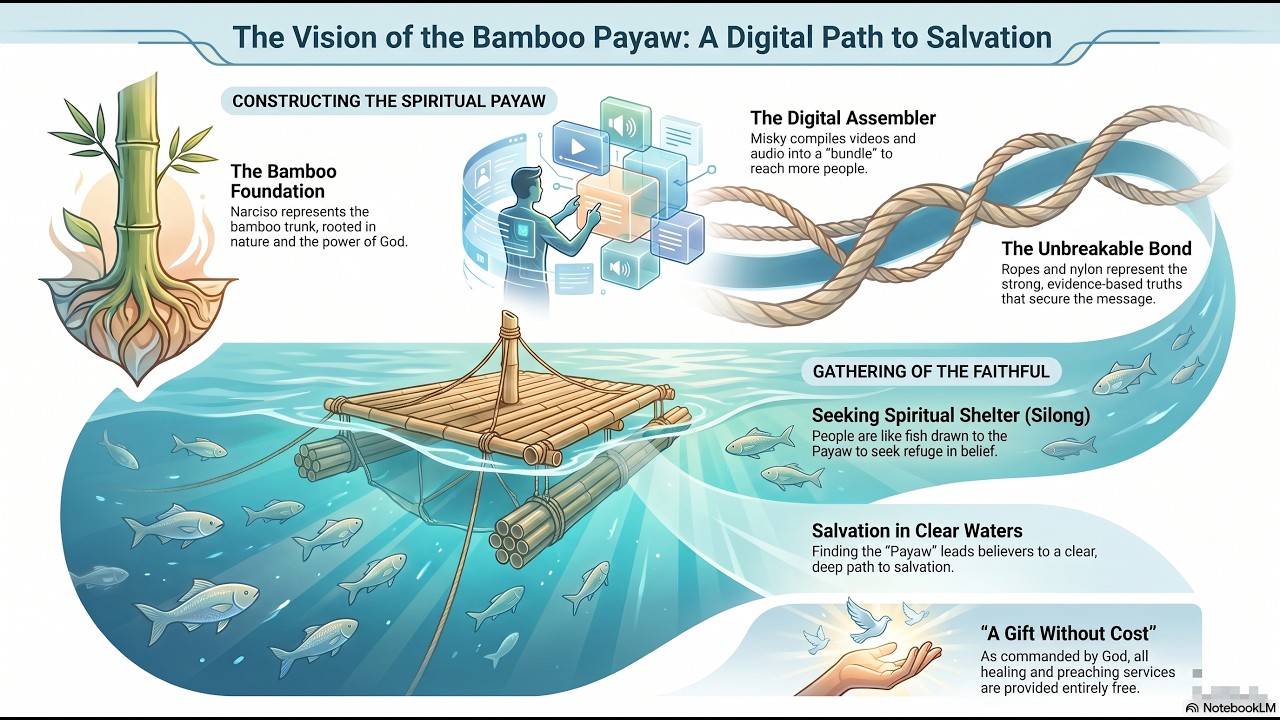
He illustrates this through practical, almost mundane acts of "hazard mitigation." In one instance, Olalo used his own expensive fishing line to tie down a drifting aluminum platform (damyo) to prevent it from becoming a danger to others or the environment. He applies the same logic to picking up a rolling bottle on a bus; to ignore it is a failure of love because it remains a potential hazard. For Olalo, picking up plastic or securing a drifting bridge is a higher expression of faith than any spoken prayer, as it protects the creator’s world and eliminates risk for others.
5. The "Three Ps" of Spiritual Survival
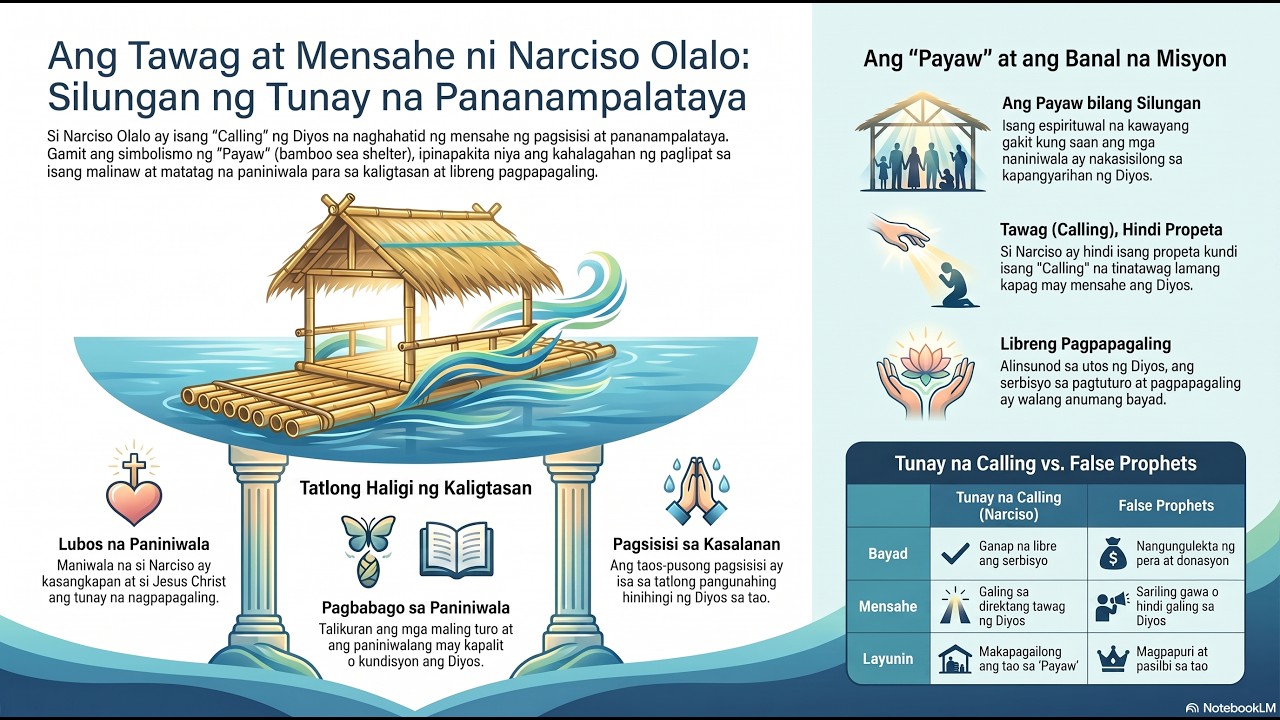
Olalo bypasses the need for "pastors, priests, or churches," whom he sharply critiques as the "No. 1 sinners" for "selling" divine words for profit. He posits that salvation is an individual responsibility achieved through a formula he calls the "Three Ps":
Pagsisisi (Repentance): A sincere acknowledgment of one's wrongs.
Pagbabago (Change): A literal transformation of actions and the abandonment of false, institutionalized beliefs.
Lubos na Paniniwala (Complete Belief): Total trust in God and the instruments He chooses.
By focusing on these pillars, Olalo argues that humanity can achieve "Spiritual Survival" without religious middlemen. He teaches that the individual must "wash" themselves through these three steps to be ready for what he claims is an approaching "Second Coming."
Conclusion: The Pattern in the Chaos
The narrative of Narciso Olalo presents a unique challenge to the modern mind. He offers no grand cathedrals, only the testimony of a maintenance worker and a series of "backups"—healings, the scanning of ancient sins, and the prediction of global tragedies—as evidence of his Calling.
Whether one views his accuracy in the Sabungero case or the retirement of ABS-CBN as mere coincidence or the manifestation of a "Power of Mind," the pattern remains difficult to ignore. Olalo’s mission serves as a reminder that in an age of complex systems, the most profound claims often emerge from the most humble sources. It leaves the intellectually curious with a singular question: is this "Power of Mind" an untapped human capability, or are we witnessing a spiritual law that logic has yet to fully map?
Comments